Chicken Road has quietly become one of the most recognizable crash-style games in the Canadian online casino scene. It doesn't lean on cinematic graphics or a sprawling feature set — it leans on a single, addictive decision repeated over and over: keep going, or cash out now? That tension, dressed up as a wide-eyed chicken dodging traffic, is the whole appeal, and it's enough to keep players coming back.
This is a full review. It covers where the game came from, exactly how it works, what every number on the screen actually means, a deep look at the four difficulty modes, a proper strategy and bankroll section, the mistakes that cost players the most, and an honest accounting of what the game does well and where it falls short. There's no magic system here — the math always favours the house — but the more you understand the mechanics, the better the experience and the longer your bankroll tends to last.
What Is Chicken Road?
Chicken Road is a crash-style instant game from InOut Games, a relatively young iGaming developer that launched the title in early 2024 as one of its first releases. It caught on fast, and a follow-up, Chicken Road 2.0, arrived about a year later with reworked visuals and tweaked difficulty curves.
The concept is deliberately simple. You control a chicken trying to cross a busy road — or, depending on the theme, a dungeon full of flames. The road is divided into lanes, and each lane you reach carries a higher payout multiplier than the one before. Step forward and survive, and your potential winnings grow. Step forward and fail, and the run ends with your stake lost. At any point, you can stop and collect what you've banked so far.
What separates Chicken Road from a classic crash game is control. In most crash titles, a multiplier rises automatically and randomly "crashes," and your only job is to bail before it does. Chicken Road hands the pacing entirely to you. Nothing advances until you choose to advance it. There's no ticking clock, no forced cash-out window — just you, the road ahead, and a running decision about how much risk is enough. That's why the game rewards judgment and discipline far more than reflexes.
Quick Overview
| Feature | Detail |
|---|---|
| Provider | InOut Games |
| Released | 2024 (Chicken Road 2.0 followed in 2025) |
| Game type | Crash-style instant game |
| RTP | 98% (well above the ~96% industry average) |
| Difficulty modes | Easy, Medium, Hard, Hardcore |
| Bet range | Roughly C$0.01 to C$200 per round (varies by casino) |
| Max win | Often capped around C$10,000, though caps differ by operator |
| Platform | HTML5 — in-browser on desktop, tablet, and mobile |
| Fairness | Provably Fair |
| Demo available | Yes — free play with virtual credits |
A reminder before anything else: bet limits, currency, and the maximum-win cap are set by each individual casino, so the figures in your game lobby are the ones that matter. The 98% RTP is consistent across listings and is one of the game's genuine strengths, but a high theoretical return doesn't soften a bad streak. Variance is real, and no number on this table changes that.
Understanding RTP and Volatility
Two numbers shape your long-term experience, and it's worth being clear-eyed about both.
RTP, or return to player, is the share of all wagered money the game is designed to pay back over a very large number of rounds. Chicken Road's 98% is generous by casino standards — many slots sit at 94% to 96%. In plain terms, the house edge is around 2%. That's favourable, but it's a long-run average across millions of rounds, not a promise about your session. You can absolutely lose over an evening with a 98% game, and plenty of people do.
Volatility is the other half of the picture, and in Chicken Road it isn't fixed — you set it yourself through the difficulty mode. Easy is low volatility: small, frequent multipliers and a high survival rate per step. Hardcore is extreme volatility: huge potential multipliers but a steep chance of getting burned early. Same RTP underneath, completely different ride on top. Choosing a difficulty is really choosing how wild you want the swings to be.
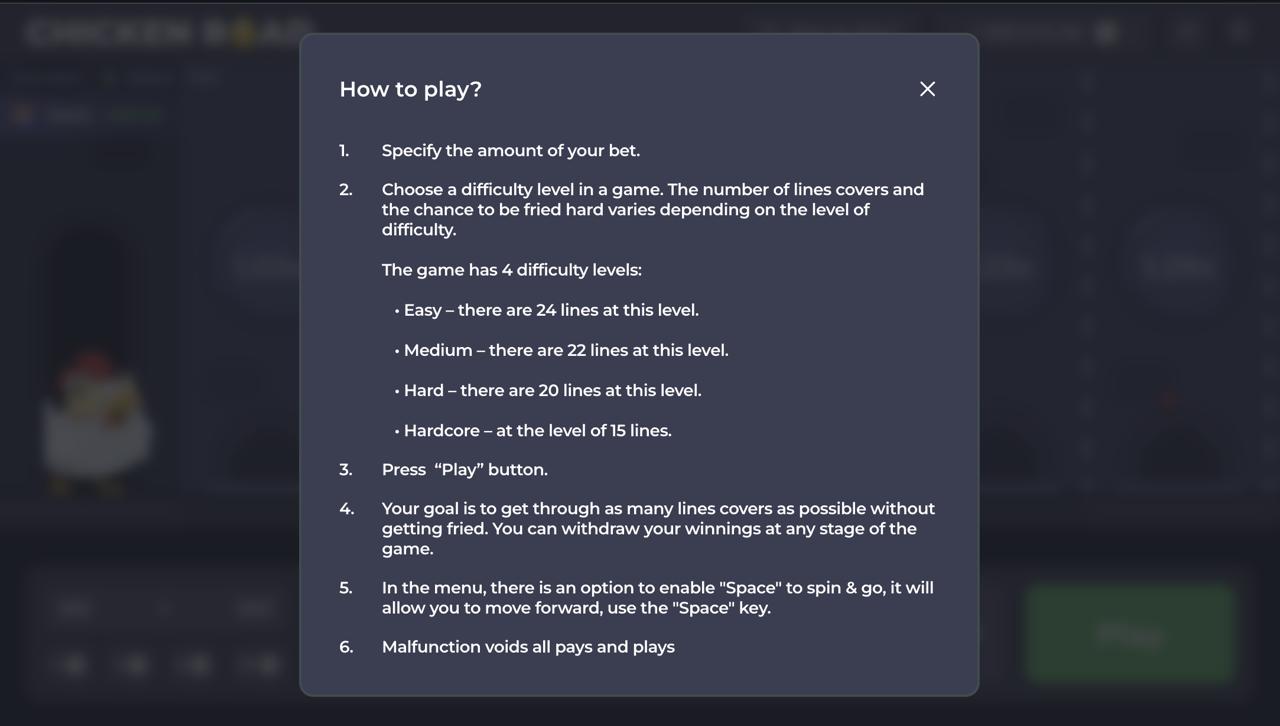
How to Play, Step by Step
The interface is clean and the loop is easy to learn. A typical round goes like this:
- Set your stake. Use the bet controls — usually in the lower corner — to choose how much you want to wager, anywhere from a few cents up to the casino's maximum. Many versions let you type a custom amount or tap preset values.
- Choose a difficulty. This is the single most consequential choice you'll make. It determines how many steps to the finish, how steep the multipliers are, and how likely a misstep becomes. More on this below.
- Start the round. Press the play button and your chicken steps onto the road, reaching the first lane and its multiplier.
- Decide after each step. With every safe lane, your potential payout grows. You then choose to advance again or cash out.
- Cash out. Hit the cash-out button to lock in your stake multiplied by the current value. If your chicken doesn't survive a step before you cash out, the round ends and the stake is lost.
On desktop, a spacebar shortcut usually advances the chicken, which makes for a fast "press and go" rhythm. On mobile, large tap targets handle the same job in landscape view.
The Four Difficulty Modes
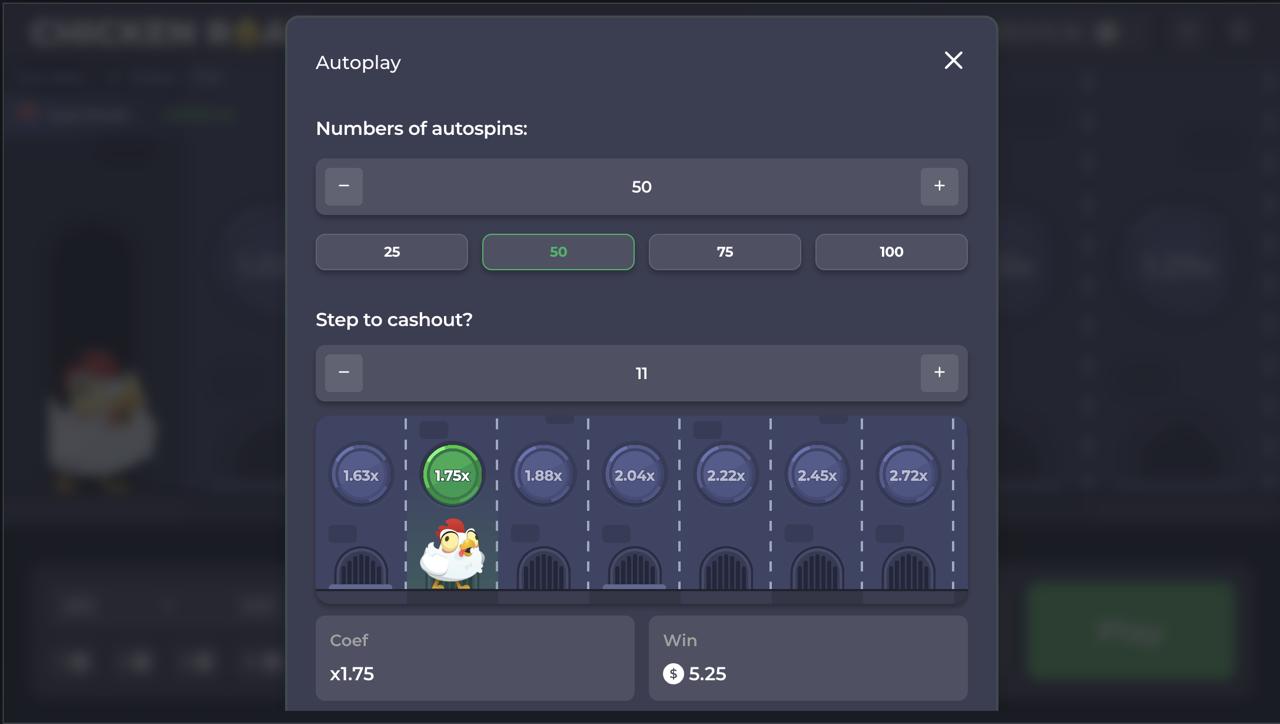
Difficulty is where Chicken Road lives or dies for each player. Pick the wrong mode for your bankroll and temperament and the game can feel either dull or brutal. Here's how the four typically break down:
| Mode | Steps | Multiplier range | Approx. risk per step |
|---|---|---|---|
| Easy | 24 | 1.03x – 19.44x | ~1 in 25 |
| Medium | 22 | 1.12x – 1,788x | ~3 in 25 |
| Hard | 20 | 1.23x – 41,321x | ~5 in 25 |
| Hardcore | 15 | 1.63x – 2,542,251x | ~10 in 25 |
Exact figures vary slightly between Chicken Road and Chicken Road 2.0, and between casinos, but the shape holds: the harder the mode, the fewer steps to the top, the steeper the multipliers, and the sharper the risk.
Easy is the gentlest. Multipliers climb slowly and survival per step is high, which makes it ideal for learning the rhythm and for grinding small, steady wins. It's the mode least likely to wipe you out quickly.
Medium is the sweet spot for a lot of players. The multipliers actually start to mean something — reaching the fifth lane already clears 2x — while the per-step risk stays manageable. It's a reasonable balance of survival and reward.
Hard ratchets things up fast. The payouts grow dramatically, but so does the chance of an early end. It suits players who want bigger swings and can stomach more frequent losses.
Hardcore is the high-wire act. The headline multipliers are astronomical, but the risk per step is roughly one in three, and remember — the maximum win is capped regardless of how high the theoretical multiplier climbs. Chasing the very top of the Hardcore range almost never makes practical sense, because the cap kicks in long before you'd realistically get there. Treat it as a thrill, not a plan.
Provably Fair Explained
Chicken Road runs on a Provably Fair system, which is worth understanding because it's one of the game's strongest selling points. Before each round, the game generates an encrypted result that's combined with data from your session to determine the outcome. Because the result is locked in and verifiable after the fact, neither the casino nor the player can rig a round. You can check the outcomes through a verification function, usually tucked into a corner of the interface.
The practical takeaway: every step is predetermined and independent. A long run of safe crossings does not make the next step safer, and a string of early deaths doesn't mean you're "due." The game has no memory, and believing otherwise — the classic gambler's fallacy — is one of the fastest ways to make poor decisions.
Tips and Strategy
None of what follows beats the house edge. The 2% is baked into the RTP and no pattern of play removes it. What these tips do is help you play with discipline, stretch your bankroll, and get more entertainment out of each session.
Start in the demo. Nearly every casino offers a free-play version on virtual credits. Use it to map how multipliers climb in each mode and to settle on a comfortable exit point before any real money is in play.
Decide your cash-out target before you press play. Improvising mid-run is the most common and most expensive mistake. Pick a target — say 1.5x to 2.5x on Medium — and cash out there consistently instead of reacting to each lane in the heat of the moment.
Match the mode to your bankroll. A small bankroll bleeds out fast on Hard or Hardcore. If you're playing for longevity and entertainment, Easy and Medium give you far more rounds for your money.
Use bankroll blocks. Split your session budget into blocks of, say, 20 to 30 rounds at a fixed stake. Within each block, hold the same bet size and the same cash-out target. This stops a cold streak from draining everything in a handful of impulsive rounds.
Never chase losses by doubling up. Increasing your stake to "win it back" rarely ends well in crash games. Each round is independent; a loss doesn't make the next round more likely to pay.
Bank winnings as you go. On a good run, withdraw a portion rather than feeding it all back in. Locking in profit is the only dependable way to leave the table ahead.
Set a stop-loss and a stop-win. Decide in advance how much you're willing to lose and what win figure would make you walk away — then actually honour both. The win limit matters as much as the loss limit.
Watch the first few steps when you switch modes. When changing difficulty, place a minimum bet first and observe how the early lanes behave before committing real stakes.
Take breaks. Fatigue erodes discipline. Stepping away resets your judgment and breaks the autopilot rhythm that leads to overplaying.
Common Mistakes to Avoid
- Chasing the jackpot multipliers. The giant Hardcore numbers are designed to be rare and are capped anyway. Building a session around them is a fast way to empty a bankroll.
- Treating demo credits as worthless. If you play recklessly in free mode, you'll carry those habits into real money. Practise as if the credits were your own.
- Believing in streaks. The Provably Fair system makes every step independent. There's no "hot" or "cold" pattern to ride.
- Skipping the limits. Playing without a budget, a stop-loss, and a stop-win is the single biggest predictor of a bad session.
- Ignoring connection quality on mobile. Because cash-out timing is yours to control, a laggy connection can cause frustrating mis-taps. A stable Wi-Fi or strong mobile signal helps.
Pros and Cons
What works well
- A high 98% RTP, friendlier than most casino games
- Full control over every decision — no forced auto-crash
- Four difficulty modes spanning very different risk appetites
- Clean, intuitive controls that run smoothly on mobile and desktop
- Provably Fair system for verifiable, transparent rounds
- A free demo that mirrors the real game exactly
- Loads instantly in-browser with no download
Worth keeping in mind
- Volatility spikes sharply on Hard and Hardcore
- The max-win cap limits the real value of the huge multipliers
- Simple gameplay can feel repetitive over very long sessions
- No autoplay in some versions, which won't suit everyone
- Availability, limits, and caps vary by casino and region
Mobile Experience
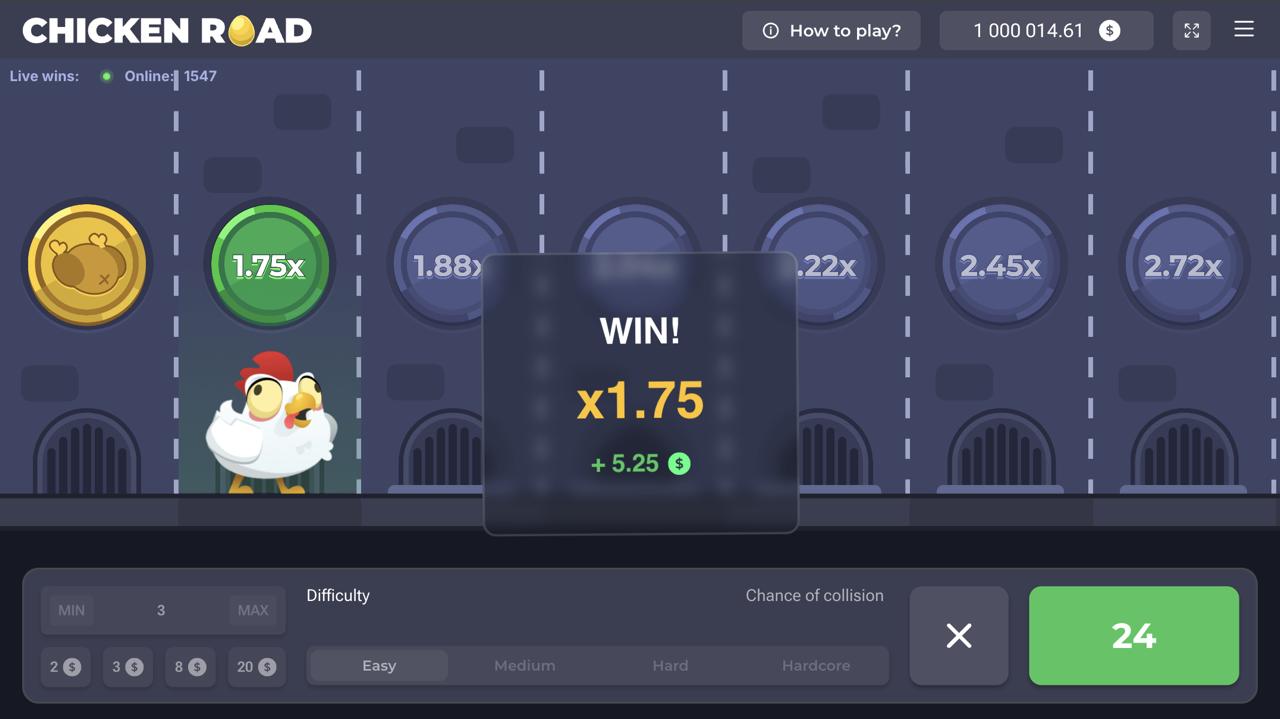
Because Chicken Road is built in HTML5, it runs in a mobile browser with no app required and adjusts automatically to your screen. The controls are designed for thumb reach in landscape view, and the tap-based pacing suits short sessions well. The one thing to watch is latency: since you decide exactly when to cash out, a slow or unstable connection can mean a missed multiplier. A reliable Wi-Fi or strong 4G/5G signal keeps the experience smooth.
Chicken Road vs. Chicken Road 2.0
If you enjoy the original, the sequel is worth a look. Chicken Road 2.0 keeps the same core loop and Provably Fair foundation but changes the setting and adjusts the difficulty curves — generally adding more lanes per mode, which makes the harder levels tougher to complete. The RTP and overall feel remain close to the original, so the choice mostly comes down to which theme and difficulty tuning you prefer. Trying both in demo mode is the easiest way to decide.
Who Is This Game For?
Chicken Road suits players who like making decisions rather than passively watching reels spin. If you enjoy a game of nerve where you control the pace and the risk, it's a strong fit — especially on Easy and Medium, where sessions can stretch out and stay engaging. It's less suited to anyone chasing elaborate features, big bonus rounds, or autoplay-driven slot marathons. And if you're new to crash games entirely, the manual cash-out and no-clock design make it one of the gentler entry points in the genre.
Responsible Play
Chicken Road is built to be fun, and it's at its best treated as entertainment rather than a way to make money. Over time the odds favour the house, and no strategy changes that. Set your limits before you start, never wager more than you can comfortably afford to lose, and take regular breaks. You must be of legal age to play for real money — generally 18+ or 19+ depending on your province.
If gambling ever stops feeling like a game, free and confidential support is available in Canada through the Responsible Gambling Council and provincial helplines. Reaching out early is always easier than waiting.
Frequently Asked Questions
It's a crash-style instant game with a twist. You advance step by step and cash out manually, rather than spinning reels.
Easy is the natural starting point. The multipliers are gentler and survival per step is higher, which makes it ideal for learning the rhythm. Medium is a sensible next step once you're comfortable.
The top multipliers on Hard and Hardcore are technically possible but extremely unlikely, and the overall payout is capped regardless. They're best seen as a novelty rather than a realistic target.
No. Unlike many crash games, Chicken Road has no ticking clock. You take your time deciding when to cash out, so it rewards judgment over reaction speed.
Yes. It uses a Provably Fair system, so each round's outcome can be independently verified and can't be altered by the casino or the player.
98%, which is higher than most casino games and gives the game a relatively low house edge of around 2%.
Yes. A demo version runs on virtual credits, usually without registration, and mirrors the real game's mechanics exactly — making it the best way to practise.
No. The house edge is built into the RTP and no system removes it. Good "strategy" is really good discipline: fixed stakes, pre-set cash-out points, and firm limits.